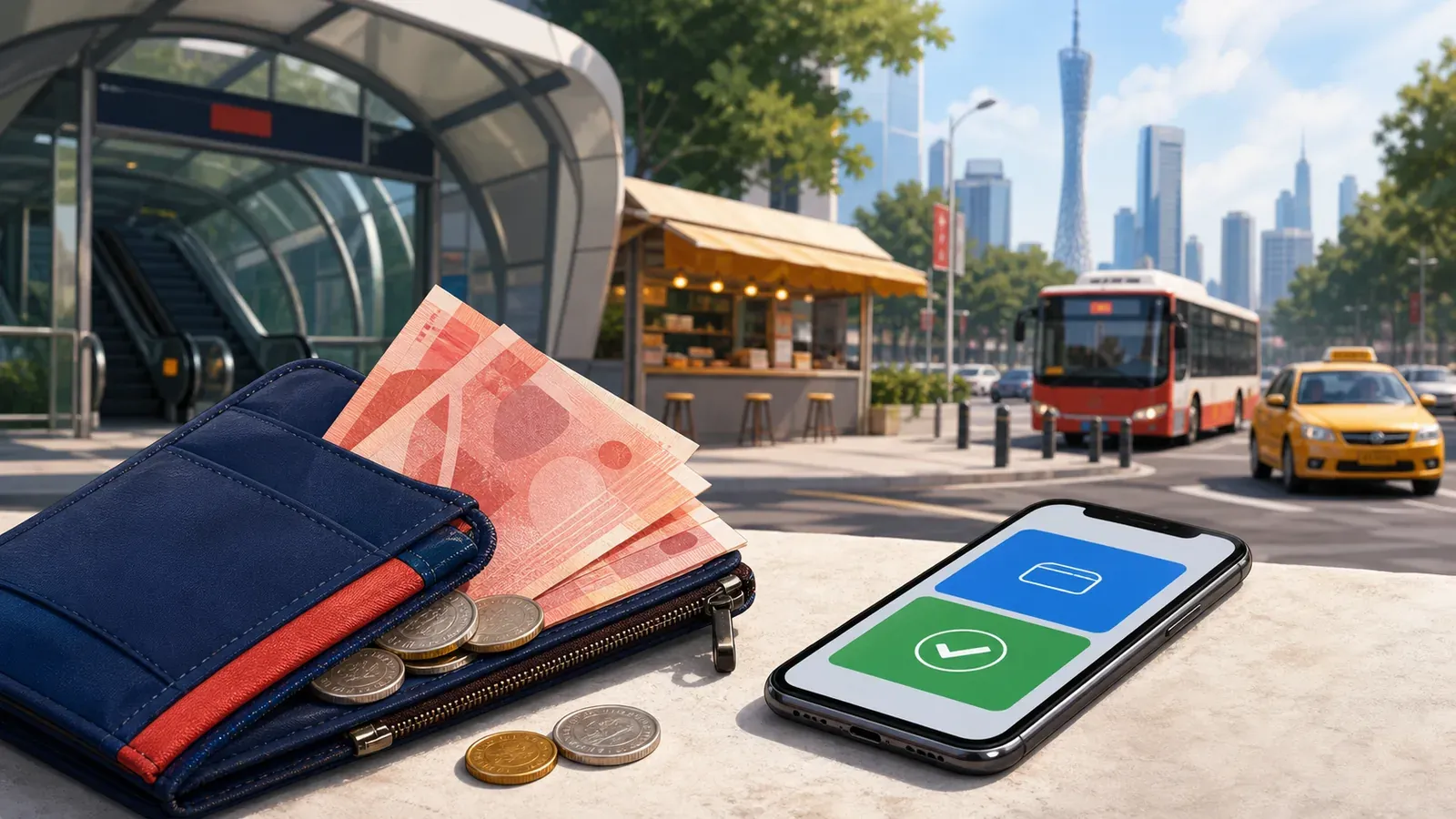
Yes, foreigners can still use cash in China. Current rules protect cash use in many face-to-face transactions. But “accepted” does not always mean “easy.” Change, ticket machines, QR menus, and app-only services can make a cash-only day slow.
I tested that difference during one full day in Guangzhou. I used no Alipay, no WeChat Pay, and no bank card for payment—only RMB cash. The test covered a local breakfast shop, 7-Eleven, Luckin Coffee, the metro, a public bus, a local lunch restaurant, and a street taxi.
All seven tests worked. I still would not recommend traveling around China with cash as your only payment method.
Quick Answer
Foreign visitors can pay with RMB cash in China. Staffed, in-person transactions generally should support cash under rules effective from February 1, 2026. Metro tickets and buses also support cash, subject to local machine, route, and fare rules.
The practical problem is convenience. A shop may struggle to change a ¥100 note. A bus may require exact fare. A restaurant may accept cash but expect a QR-menu order. Delivery, shared bikes, rentals, ride-hailing, and bookings may have no physical cashier.
My practical setup is:
- Alipay or WeChat Pay as the main payment method
- a second payment app or foreign card as backup
- a few hundred RMB in cash, adjusted to your itinerary
- small notes and coins, especially ¥10 and ¥20 notes
For the phone-payment side of this setup, see How to Use Alipay and WeChat Pay in China.
My Real Cash-Only Test in Guangzhou
Scope of this test
This was one real Guangzhou test, not a promise about every city or merchant.
| Test | Result | What mattered |
|---|---|---|
| Local breakfast shop | Cash accepted | The ¥8 bill made a ¥100 note an awkward way to pay. |
| 7-Eleven | Cash accepted | This store successfully provided smaller change. |
| Luckin Coffee | Cash accepted with a staff-assisted counter order | The app-based ordering flow was smoother and could show different offers. |
| Metro | Cash accepted for a single-journey ticket | Coins and small notes were easier; a service counter may be needed for a large note. |
| Public bus | Cash accepted | The tested ¥2 fare box did not give change. |
| Local lunch restaurant | Cash accepted at the counter | Ordering through a QR menu was harder than paying. |
| Street taxi | Cash accepted | I used a street-hail taxi, asked first, showed the destination in Chinese, and carried small bills. |
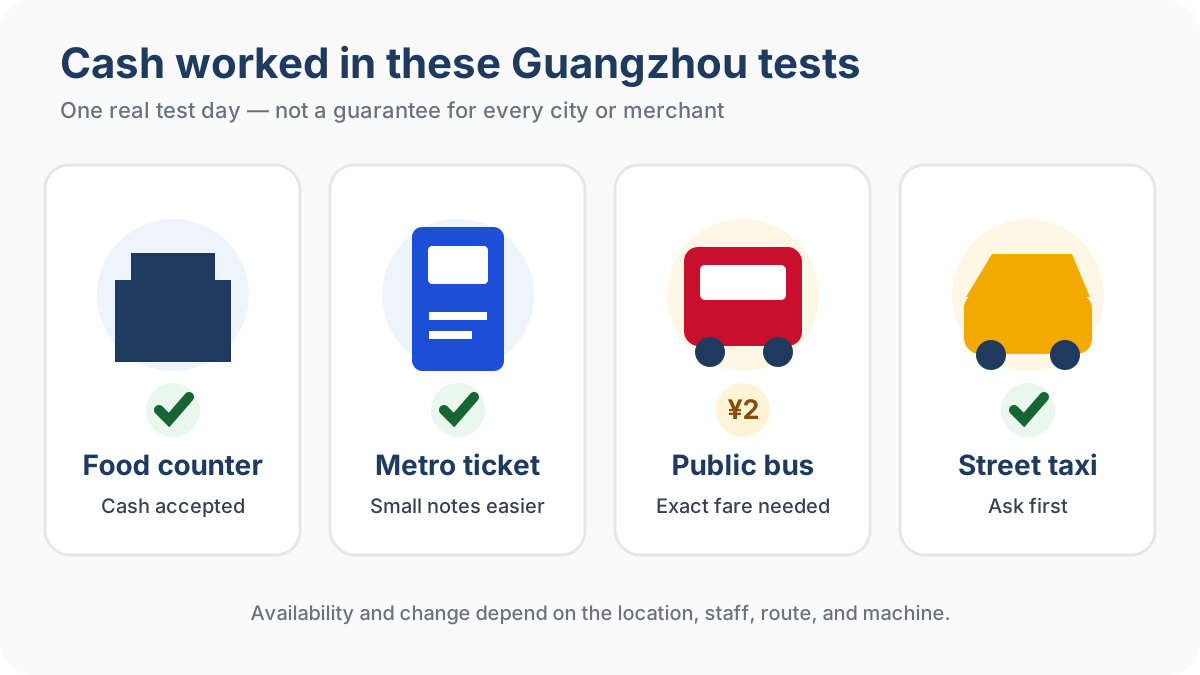
The lesson was not “cash does not work.” It was: cash works for many physical transactions, while the surrounding process is often designed for a phone.
Breakfast shop: the change problem
Breakfast cost ¥8. Paying with cash was possible, but using a ¥100 note for a small purchase can force a shop to find ¥92 in change. That is inconvenient for both sides, especially early in the day when the till may be light.
Carry smaller notes before you visit a tiny shop. The video mentions asking a nearby shop for change as something that may happen, but that was not treated as a guaranteed service.
7-Eleven: one successful way to get smaller notes
The 7-Eleven test passed, and the store was able to break a large note after a small purchase. A staffed convenience store can be a practical place to ask for change, but do not assume every store will always have enough cash in its till. Ask politely before making your plan depend on it.
Luckin Coffee: cash worked, but the app was the normal route
At the tested Luckin branch, staff helped place an order at the counter and accepted cash. The friction was the missing app flow: most customers ordered on a phone, and app offers could differ from the counter experience.
This is an important distinction. A physical shop may accept your cash while still making ordering, discounts, loyalty benefits, or pickup much easier through its app.
Metro: a cash ticket works, but it can take longer
I bought a single-journey ticket with cash. The ticket machine accepted coins and small notes in this test; a large note could mean using the service counter.
Official guidance says foreign travelers can buy metro tickets or passes at ticket offices or supported machines using RMB cash. Denominations and ticket options vary, so follow signs or ask staff.
In Guangzhou, supported contactless foreign bank cards are now another option at metro gates. That does not replace cash, but it gives travelers a useful backup when their payment app is not ready.
Public bus: prepare the exact fare
The Guangzhou bus was the hardest cash test. The fare was ¥2, and the fare box did not return change. With the exact amount, the ride was simple. With only a ¥100 note, it would not have been practical.
Official visitor guidance confirms that buses can take RMB cash and specifically advises travelers to prepare small change. The fare and boarding process still vary by route and city.
Restaurant: ordering can be harder than paying
The lunch restaurant accepted cash at the counter. The more difficult step was ordering: the menu was accessed through a QR code and mini program, and a digital flow may be only in Chinese or ask for a local phone number.
If you are traveling without mobile payment, look for a staffed counter, paper menu, photo menu, or a restaurant where staff can take the order directly. Translation on your phone can help even when the phone is not used for payment.
Street taxi: not the same as Didi
I tested a traditional street-hail taxi, not Didi. Cash worked after I prepared the destination in Chinese, asked the driver whether cash was okay, and used small bills.
Didi and other ride-hailing options are booked through an app. Official visitor guidance describes registering with a foreign phone number and using an international card in Didi-Greater China. Because the cash-only video did not test Didi, do not read this article as proof that a Didi trip can be settled in cash. Check the payment methods shown in the app before booking.
Can Shops Refuse Cash in China?
For many ordinary in-person transactions, they should not simply refuse RMB cash.
China’s current Rules on RMB Cash Receipt, Payment and Services took effect on February 1, 2026. Manual collection, face-to-face service, and online transactions that finish with in-person delivery—when face-to-face collection is possible—must support cash.
There are operational distinctions:
- Self-service or unattended systems must display payment methods and provide a reasonable cash-conversion or service route for special cases; the machine itself may not accept every note.
- A service completed entirely online must disclose its supported payment methods in advance.
- Businesses that support cash should keep a reasonable amount of change.
If you believe a staffed business improperly refused cash, keep calm, ask whether there is a cashier or alternate collection method, and preserve basic evidence. The regulation says consumers may seek help from the local branch of the People’s Bank of China. This article is practical travel guidance, not legal advice.
How to Get RMB Cash
Foreign visitors have several legitimate options:
- Withdraw from an ATM. Look for the logo of your card network on the machine. Do not assume every ATM accepts every overseas card. Your bank or the ATM operator may apply limits or fees.
- Use a bank branch or marked exchange outlet. Currency availability and identification requirements vary. Bring your passport.
- Use a licensed exchange counter or supported self-service machine. Airports and ports of entry are common locations; some hotels and other areas may also offer exchange services.
- Ask a bank for small denominations. Official guidance says bank outlets provide small-note exchange services, and some offer pre-packed “change purse” products.
Avoid exchanging money with unlicensed individuals. Check the displayed rate and fees before confirming an exchange.
How Much Cash Should You Carry?
There is no official universal amount. In the video, my practical starting point is a few hundred RMB as backup, not as your full trip budget.
Adjust it for time away from your hotel, whether your apps and cards are tested, planned use of buses or small shops, phone connectivity, and your normal cash-security precautions.
Split the cash between your wallet and a secure backup location. Do not carry only ¥100 notes. A useful mix includes ¥10 and ¥20 notes plus coins or small notes for transport.
What Physical Cash Cannot Do Well
Some modern services begin and end on a phone. Food delivery, ride-hailing, shared-bike unlocks, power-bank rentals, and some attraction reservations may have no counter where you can hand someone a banknote.
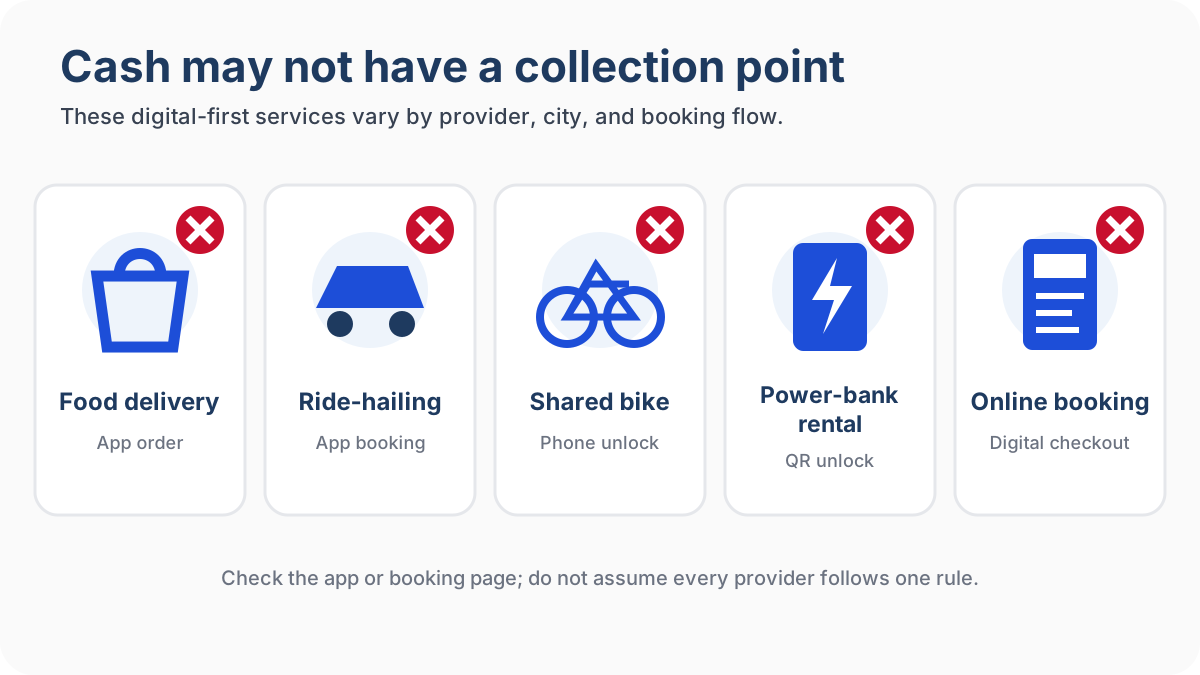
That does not mean every provider has one nationwide rule. It means a cash-only traveler cannot assume a physical collection point exists. Check the app or booking page before relying on the service.
This is also why “shops accept cash” and “you can travel smoothly with cash only” are different claims.
Common Cash Mistakes
Carrying only ¥100 notes
Large notes are legal money, but a small shop or taxi may not have convenient change. Get smaller denominations early.
Assuming the bus will give change
Prepare the local fare before boarding. If you do not have it, use another transport option or obtain change first.
Confusing payment with ordering
A restaurant may accept cash while requiring a QR menu or mini program to order. Choose a staffed or paper-menu alternative when possible.
Treating one Guangzhou test as a national guarantee
City systems, merchant operations, machine settings, and staff practices vary. Use the test as a practical example, not a promise.
Depending on cash for online services
Check the payment step before ordering a ride, meal, ticket, bike, or rental. If there is no physical cashier, cash in your pocket may not help.
Best Backup Plan
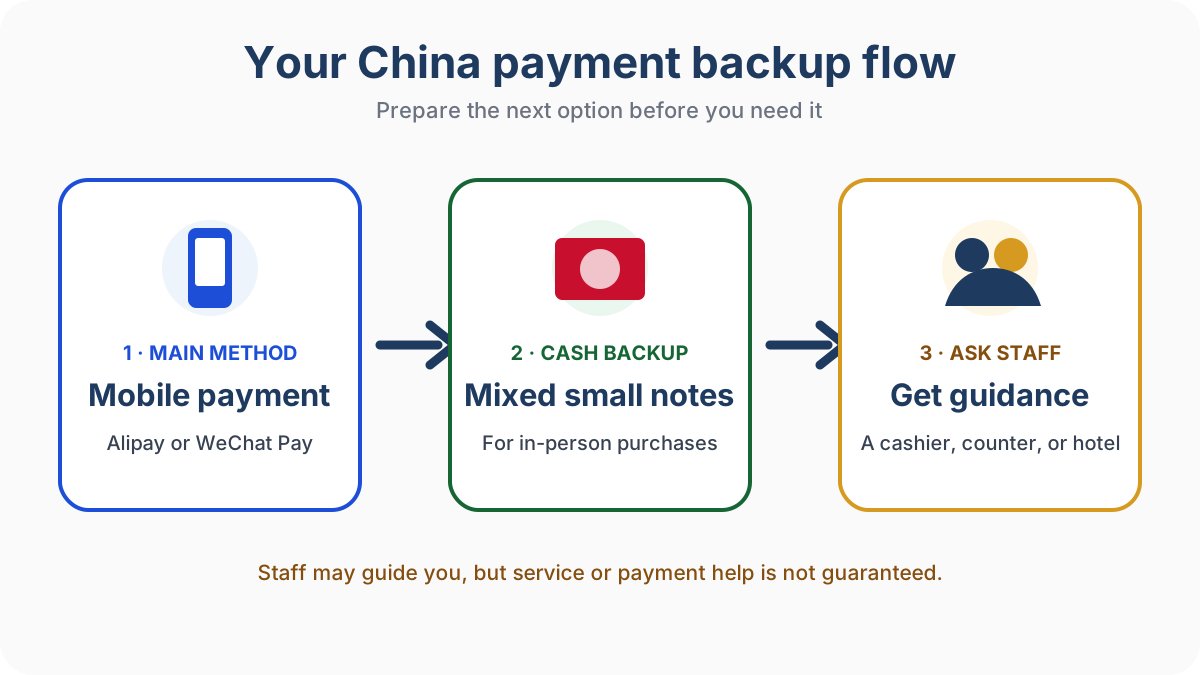
- Set up Alipay or WeChat Pay before your trip and link an eligible foreign card.
- Keep a second app or bank card available.
- Carry a few hundred RMB in mixed small denominations as a backup.
- Keep your phone charged and your data connection working.
- Save your hotel name, address, and destination in Chinese.
- If a payment fails, try the second app or card, use cash for an in-person purchase, or ask a staffed service counter or hotel front desk for guidance.
These steps are easier if you also prepare internet access and complete the pre-trip checklist before flying.
Mr. Panda’s Local Tip
Solve the small-change problem before you need the bus. Ask a bank for smaller notes, or make a normal small purchase at a staffed store and politely ask whether the cashier can break your larger note. Do not wait until you are boarding with a line behind you.
Cash is a strong backup. It is a frustrating Plan A when every step around the payment—ordering, unlocking, booking, or finding change—expects a phone.
FAQ
Can foreigners legally use cash in China?
Yes. RMB cash is a supported payment method, and current rules protect cash acceptance in many face-to-face transactions. Operational exceptions and different rules for self-service or fully online services still matter.
Do restaurants and convenience stores accept cash?
Many staffed restaurants and stores do, and cash worked in both types of business during the Guangzhou test. Ordering systems and change availability can vary, so carry small notes and ask staff if the process is unclear.
Can I use cash on the metro?
Official visitor guidance says single-journey metro tickets can be bought at ticket offices or supported machines with RMB cash. The accepted denominations and machine setup vary by city and station.
Can I pay cash on a bus in China?
Cash is an available bus payment method in official visitor guidance, but small change is recommended. The tested Guangzhou bus required the exact ¥2 fare and gave no change.
Can I pay a street taxi with cash?
Cash worked in Mr. Panda’s Guangzhou street-taxi test. Ask before the ride, show the destination in Chinese, and carry small bills. Do not assume an app-booked ride uses the same payment process.
Can I use Didi with cash?
The cash-only video did not test Didi. Official guidance presents Didi as an app-based service supporting foreign registration and international cards. A cash-only traveler should check the app’s offered payment methods and keep another transport option.
Where can I get small RMB notes?
Ask at a bank counter, use a supported small-note exchange or “change purse” service, or politely ask for change during a normal staffed purchase. Availability is not guaranteed at every location.
Watch the Guangzhou Cash-Only Test
The video shows the seven Guangzhou scenarios behind this guide. It is evidence of one day and one set of locations, not a guarantee for every merchant or city.
Sources and Last Checked
Last checked: July 11, 2026.
- Current RMB cash receipt and payment regulation
- State Council guide for foreigners working and living in China
- State Council payment guide for overseas visitors
- People’s Bank of China payment-service opinion
- Guangzhou payment handbook
- Mr. Panda’s Guangzhou cash-only video and supplied subtitles
For the rest of your payment setup, continue with the Alipay and WeChat Pay guide or review all China Essentials guides.
